Memphis WeatherOvercast. High 77°, low 46°.
Chance of rain 1%.

Dalton Daily

Sourced widely. Told plainly.
Vol. I · No. 3Morning edition
daltondaily.com
Markets · loading

Technology & Science

Technology

Hackers cooked supermarket fridges across France; investigators point to Danfoss controller flaw
Al Jazeera

Hackers cooked supermarket fridges across France; investigators point to Danfoss controller flaw

Paris prosecutors have opened an inquiry into the 'unprecedented' attack on refrigeration systems at several major grocery chains.

PARIS — A cyberattack overnight on Oct. 11-12 pushed temperatures in supermarket fridges and freezers as high as 50C (122F), ruining stock and starting fires at several stores. Retailers' counts differed. Intermarché and its Netto brand reported 150 to 300 stores hit, Coopérative U said about 100, Carrefour said 80 of its roughly 6,000, and Monoprix said about 5 percent of its stores. E. Leclerc also reported some stores affected. An Intermarché executive put losses at tens of millions of euros in a single day. France's cyber agency ANSSI has identified a vulnerability in software from Danish firm Danfoss. Danfoss says the affected units ran outdated firmware and that it had urged customers to update. Security firm Claroty had published research in August on an authentication bypass in Danfoss systems. Paris prosecutors have opened an investigation. No attacker has been publicly identified.

Why it mattersThe attack shows how internet-connected industrial equipment, such as cold-chain controllers, can be turned into a physical weapon against food supply, and it raises questions about who is responsible for patching vendor-managed devices.


Al Jazeera foreign · France 24 foreign · CBS News (with AFP)
Oracle Health's legacy Cerner breach now put at nearly 20 million patients
Fox News

Oracle Health's legacy Cerner breach now put at nearly 20 million patients

Texas attorney general filing lists almost 3 million Texans among those affected by the early-2025 intrusion.

Filings with the Texas Attorney General indicate that about 19.9 million people had personal and medical data compromised in a cyberattack on Oracle Health's older Cerner systems, according to a report published Monday. That is far larger than earlier patient notices suggested. The state's breach portal posted Cerner's entry on Oct. 2 and lists 2,992,244 affected Texas residents. The intrusion dates to early 2025. Exposed data may include Social Security numbers, diagnoses and medical images. BleepingComputer previously reported that an extortionist calling himself 'Andrew' contacted affected hospitals, demanded cryptocurrency, and threatened to leak or sell the records. Oracle's own account of the national total was not part of the report, and the nationwide figure rests on the filings as relayed by the outlet.

Why it mattersIf the figure holds, this is one of the largest health-data breaches on record, and it falls on hospitals that depended on a vendor's legacy platform after an acquisition.

Fox News
Southern Company tells 400,000 utility customers their portal data was accessed
SecurityWeek

Southern Company tells 400,000 utility customers their portal data was accessed

Georgia Power, Alabama Power and Mississippi Power accounts affected; cause and timing remain undisclosed.

ATLANTA — Southern Company is notifying about 400,000 customers that an unauthorized party reached their account information through its online customer portal. About 300,000 are Georgia Power customers and roughly 100,000 are Alabama Power customers, around 6 percent of that utility's base. Mississippi Power is named in the notice without a figure. Exposed fields include names, mailing addresses, phone numbers, emails and the last four digits of Social Security numbers, plus basic account details. Bank account, payment card and driver's license numbers were not included, the company says. Southern says it detected suspicious activity, acted to stop it, notified law enforcement and has found no sign of continuing access. It has not said when the intrusion occurred or how the attacker got in. Customers are being offered one year of credit monitoring, and analysts note the data is enough to make phishing lures convincing.

Why it mattersPartial Social Security numbers tied to real account details are useful to scammers, and the lack of disclosed cause leaves other utilities guessing at the risk to their own portals.

CISA's new directive ranks federal patching by exposure and takeover risk
Wikimedia Commons

CISA's new directive ranks federal patching by exposure and takeover risk

BOD 26-04 ties urgency to known-exploited flaws on internet-facing systems, and asks agencies to check for prior compromise.

WASHINGTON — The Cybersecurity and Infrastructure Security Agency is pointing agencies to Binding Operational Directive 26-04 in its latest vulnerability alerts. The directive tells federal civilian agencies to fix, quickly, flaws in its Known Exploited Vulnerabilities catalog that sit on publicly exposed assets and give an attacker total control once exploited. Lower-risk items can be deferred. It also sets baseline expectations for when agencies must check whether attackers got in before a patch was applied. On Oct. 15 CISA added an Atlassian flaw, CVE-2026-21589, to the catalog, and its Oct. 16 BeyondTrust alert directs readers to the same guidance. The directive binds only federal civilian agencies, but CISA encourages all organizations to adopt risk-based prioritization. The agency says it will keep adding vulnerabilities that meet its criteria.

Why it mattersFederal patch rules often become the de facto benchmark for private-sector security teams, and this one shifts the emphasis from patching everything to patching what is exposed and exploitable first.

Artificial Intelligence

Lone hacker let AI agents breach 100-plus company sites, researcher says
SBS News (Korea)

Lone hacker let AI agents breach 100-plus company sites, researcher says

NorForge findings, reported by Reuters, put the cost near $50 per intrusion; the extent of data theft is unknown

WASHINGTON — A Chinese-speaking hacker handed most of the work of breaking into company websites to AI agents, according to a Reuters exclusive published Oct. 19 and based on research by the security firm NorForge. Researcher Snorre Fagerland found the operation while scanning for exposed installations of Cairn, an open-source agent platform. He says the agents tried more than 1,200 mostly e-commerce sites in the U.S., Canada, Australia and Japan from Sept. 25 and got into more than 100. A successful break-in took about 23 hours. The operator's instructions ran under 100 Chinese characters. Token costs were roughly $5,000, or about $50 per success. Worker names suggested Claude Code running a DeepSeek model, but NorForge did not confirm the full setup. Deere said it found no sign that sensitive data was accessed. SharkNinja said the affected site was a standalone product-support page. Cummins is investigating a third-party vendor's site. Reuters could not determine how much data, if any, was taken.

Why it mattersIf one person can run intrusions at this scale for a few thousand dollars, defenders can no longer assume attacks are limited by human labor.

Cybersecurity News trade · SBS News (Korea) foreign
DHS orders DeepSeek stripped from federal civilian systems under 2018 supply-chain law
CyberScoop

DHS orders DeepSeek stripped from federal civilian systems under 2018 supply-chain law

Order also reaches third-party tools built on the Chinese lab's models; it does not cover private or consumer use

WASHINGTON — The Department of Homeland Security has ordered federal civilian agencies to remove DeepSeek products from their IT systems and to stop buying them. The notice is due in the Federal Register today. It rests on the Federal Acquisition Supply Chain Security Act of 2018 and a review by the Federal Acquisition Security Council. It covers Hangzhou DeepSeek Artificial Intelligence and its affiliates. It also covers third-party products and services developed using DeepSeek implementations, which would likely include tools built on its open-weight models. Secretary Markwayne Mullin cited data-transfer and malware risks. A copy of his letter in the notice is dated June 26, so the ban has been in place for months. Agencies can seek exceptions within 60 days, with CISA deciding each request. DeepSeek has 60 days after notice to challenge the order in the D.C. Circuit. The order does not reach private companies or consumers.

Why it mattersThis is the first use of a federal supply-chain exclusion law against a Chinese AI model developer, and it extends to contractors' software that uses DeepSeek.

CyberScoop trade · BankInfoSecurity trade · Engadget
Judge signals he will likely grant Apple injunction against OpenAI in hardware trade-secret case
Crypto Briefing

Judge signals he will likely grant Apple injunction against OpenAI in hardware trade-secret case

No ruling yet; early depositions of OpenAI's hardware chief and a former Apple engineer are ordered

SAN JOSE — U.S. District Judge Edward Davila said at an Oct. 14 hearing that he is highly likely to grant Apple a preliminary injunction against OpenAI, its io Products unit and two former Apple employees. He has not yet ruled. Apple sued July 10 in the Northern District of California (5:26-cv-07078). It alleges a coordinated effort to take confidential hardware designs and manufacturing knowledge. The individual defendants are engineer Chang Liu and Tang Tan, now OpenAI's chief hardware officer. One day before the hearing, the judge granted part of Apple's request for expedited discovery. That order requires forensic images and communication records and allows early depositions of four people, including Liu and Tan. OpenAI has called the accusations groundless and retaliatory. An injunction could force OpenAI to show its devices do not rely on the disputed material. Reports say it is aiming for a speaker in 2027.

Why it mattersAn injunction could constrain OpenAI's push into consumer hardware and test how courts treat talent moves between big technology firms.

Nvidia releases open Nemotron 3.5 models for enterprise and local agents
TechCrunch

Nvidia releases open Nemotron 3.5 models for enterprise and local agents

Speed advantage over OpenAI and Anthropic models is Nvidia's own claim, tied to task-specific post-training

SANTA CLARA, Calif. — Nvidia has released new open-weight models for always-on agents. Nemotron 3.5 Super VL has 120 billion parameters and targets enterprise agents. Nvidia says it matches the larger Nemotron 3 Ultra on instruction-following and tool use. The company also says it finishes tasks faster than competing models from Anthropic and OpenAI, including Opus 5 and GPT 6.1 Sol, but only after post-training on specific agentic tasks. No independent test of that comparison has been reported. At the small end are two Bolt models. Nemotron 3.5 Bolt 74B-A9B 24GB is a 74-billion-parameter model meant for local agent work on PCs. Super VL and that Bolt model are available now. A smaller Bolt E4B is due later this month. Kari Briski, Nvidia's vice president of open models and software, said organizations can now run agents on Nvidia infrastructure without trading capability for deployability.

Why it mattersOpen models tuned to Nvidia hardware give enterprises a self-hosted alternative to paid frontier APIs, at a time when Chinese open models face federal restrictions.

OpenEvidence and Doximity settle prompt-injection espionage suit
Fierce Healthcare

OpenEvidence and Doximity settle prompt-injection espionage suit

All claims and counterclaims dismissed with prejudice; settlement terms undisclosed

BOSTON — Medical AI companies OpenEvidence and Doximity have settled their federal lawsuit in the District of Massachusetts. They reached a settlement in principle Thursday, and all claims and counterclaims were dismissed with prejudice Friday. Each side bears its own costs and fees, and the joint notice gave no terms. OpenEvidence sued in June 2025. It alleged that Doximity staff posed as physicians, misused National Provider Identifier credentials and used prompt-injection prompts to extract its system instructions. It later dropped trade-secret claims and pursued computer-fraud, contract and unjust-enrichment claims. Doximity denied the allegations and countersued for defamation, false advertising and unfair business practices. In January, Judge Richard Stearns let both sides' main claims proceed. The case was in discovery, and OpenEvidence faced a deadline to produce communications after a dispute over deleted Slack and messaging history, when the parties settled.

Why it mattersThe case was an early test of whether prompt-injection attacks on a commercial chatbot can support computer-fraud claims, and the settlement leaves that question unanswered.

Fierce Healthcare trade

Science

Nature study: 44% of reef-building coral species face elevated extinction risk
Wikipedia

Nature study: 44% of reef-building coral species face elevated extinction risk

A peer-reviewed reassessment of 892 species attributes most of the risk to projected ocean heat stress

A paper published this week in Nature reassesses the IUCN Red List status of all 892 reef-building coral species, last assessed in 2008. Of the 774 species with enough data, 340 (44%) were classed as threatened: 33 critically endangered, 251 endangered and 56 vulnerable. The authors, including David Obura, Beth Polidoro and Francoise Cabada-Blanco, had little species-level population data. They inferred declines from global coral-cover trends and projected severe bleaching under a middle-of-the-road emissions scenario (SSP2-4.5) over three decades, adjusted for each species' vulnerability. Projected thermal stress was the main driver. The paper stresses that the Red List measures relative extinction risk and does not forecast whether or when a species will disappear. The authors say future assessments need species-level population data. The paper is peer-reviewed.

Why it mattersCoral reefs support fisheries, tourism and coastal protection in more than 100 tropical countries, and this is the most comprehensive formal accounting yet of how many species are at risk.

Personalized ovarian cancer vaccine shows immune responses in small early trial
CancerNetwork: Personalized Cancer Vaccine Combo Is Feasible in Platinum-Sensitive Ovarian Cancer (cites Nature Medicine, doi:10.1038/s41591-026-04717-8)

Personalized ovarian cancer vaccine shows immune responses in small early trial

Phase 1 study in Nature Medicine; ten patients, no efficacy conclusions yet

Researchers reported in Nature Medicine, published online October 14, a phase 1 trial of personalized vaccines targeting each patient's own tumor mutations in platinum-sensitive ovarian cancer. The trial was small, with ten patients, and was designed to test feasibility and immune response, not to prove the vaccine works. Eight of the ten patients showed an interferon-gamma immune response to at least one vaccine peptide pool. Of 144 vaccine peptides, 85 (59%) provoked an immune response. Patients whose disease was held in check, either temporarily or for longer, responded to more of the targeted mutations than patients whose cancer progressed. The averages were 9.3 and 5.5 mutations respectively, with a P value of .029. More than 73% of target mutations were still detectable in blood DNA at the final booster, despite a median 6.5-month gap between biopsy and first vaccination. Larger trials would be needed to test clinical benefit.

Why it mattersPersonalized neoantigen vaccines are a leading experimental approach in cancer immunotherapy, and ovarian cancer has few durable options once it recurs.

Satellite data suggest two active magma reservoirs under Nicaragua's Masaya volcano
Penn State: Double trouble: Two active magma reservoirs indicated at Masaya volcano

Satellite data suggest two active magma reservoirs under Nicaragua's Masaya volcano

Penn State study in Geophysical Research Letters; no immediate hazard identified

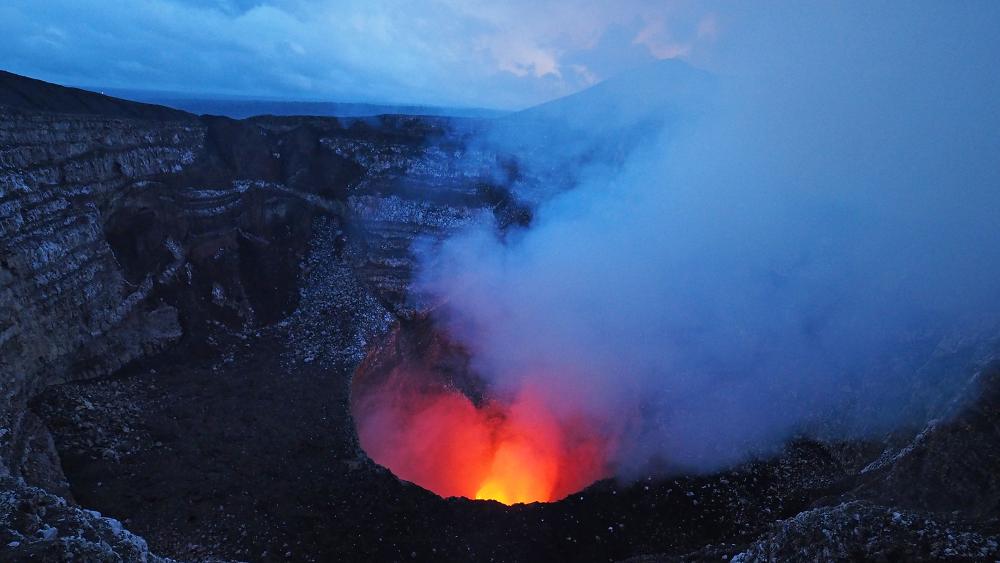
Researchers at Penn State report evidence of two distinct magma reservoirs beneath Masaya, an active Nicaraguan volcano near Managua. About 2 million people live within roughly 13 miles of it. The study, published in Geophysical Research Letters, analyzed six years (2018 to 2024) of Sentinel-1 radar satellite data. The ground inside the caldera first sank and then rose, which the team interprets as fresh magma entering a deeper reservoir. The area around the active Santiago crater and its lava lake kept sinking throughout, which suggests a separate, shallower source behaving independently. The findings are inferences from ground deformation and a simplified model of the reservoirs, not direct imaging. The authors say no immediate hazard was identified, and that longer-term monitoring and modeling are needed to improve eruption forecasting.

Why it mattersA better picture of Masaya's plumbing could sharpen hazard monitoring at a volcano that produces both gentle and explosive activity near a major population center.

Space Exploration

Japan's MMX probe launches toward Mars and its moon Phobos
CNN: What exactly are Mars' two moons?

UPDATEJapan's MMX probe launches toward Mars and its moon Phobos

H3 rocket places the sample-return spacecraft on course; JAXA confirms separation about 71 minutes after liftoff

TANEGASHIMA, Japan — Japan's Martian Moons eXploration (MMX) spacecraft lifted off on an H3 rocket from Tanegashima Space Center at 4:41 a.m. Tuesday local time, which was Monday afternoon in the United States. JAXA says the rocket flew as planned. The spacecraft separated about 71 minutes after launch and entered its planned orbit. This follows the earlier report that the mission was scheduled. MMX is meant to study Mars' two moons, Phobos and Deimos, then land on Phobos and collect surface material from two sites. The sample would come from a coring drill and a gas-driven pneumatic sampler. After collecting it, the spacecraft is to leave for Earth in 2030. NASA supplied a neutron and gamma-ray spectrometer, and European partners contributed hardware. If it works, MMX would be the first mission to return material from a Martian moon.

Why it mattersA successful return would help settle whether Phobos and Deimos are captured asteroids or debris from an ancient impact on Mars, and it would give Japan a lead in Mars-system sample return.

Europe's Euclid telescope discovers its first new comet
ESA news release: Euclid discovers new comet (via EurekAlert)

Europe's Euclid telescope discovers its first new comet

C/2026 S1 (Euclid) turned up in galaxy-survey images, 1.3 billion km away on a steep orbit

PARIS — The European Space Agency announced Monday that its Euclid space telescope has found a comet no one had catalogued. It is the first new comet the galaxy-mapping observatory has discovered. The object is designated C/2026 S1 (Euclid). Helsinki doctoral student Mikko Pöntinen's moving-object software flagged a streak in images taken between Sept. 16 and 24. Follow-up showed a fuzzy coma of dust and gas, and the Minor Planet Center confirmed the comet on Oct. 8. It lies about 1.3 billion kilometers from Earth, between the orbits of Jupiter and Saturn. Its orbit arches steeply above the plane of the planets and takes thousands of years to complete. Euclid avoids the dusty plane of the solar system, which makes such finds unlikely. ESA says the comet is not a candidate target for its Comet Interceptor mission, but the alert process was a useful test of how the two mission teams will coordinate.

Why it mattersThe find shows that wide-field survey telescopes can catch distant comets early, which could help pick future targets for spacecraft.

Dragon delivers final space station solar arrays; spacewalks to install them are next
NASA: Science, Cargo Launch on 35th SpaceX Resupply Mission

Dragon delivers final space station solar arrays; spacewalks to install them are next

NASA schedules a briefing on U.S. spacewalks 100 and 101 to complete the power upgrade

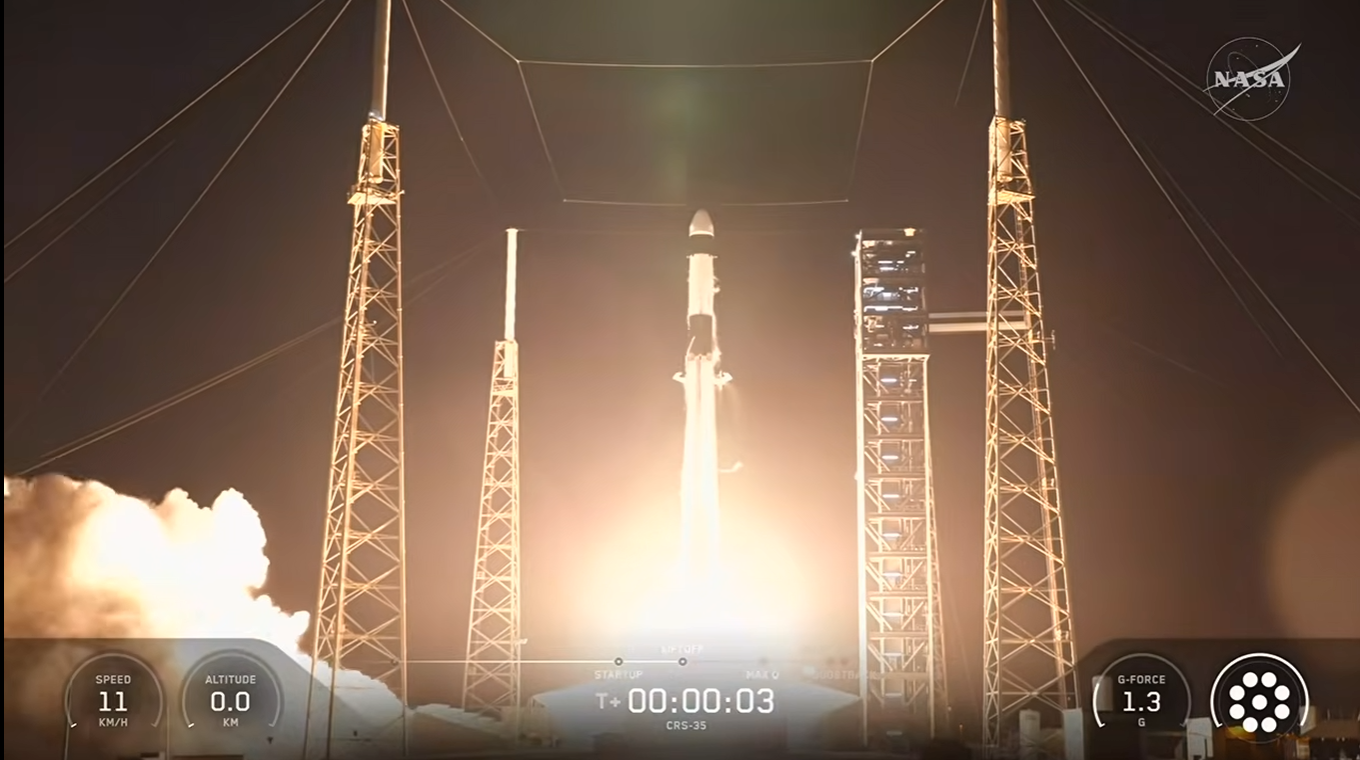
SpaceX's 35th NASA cargo mission to the International Space Station launched Oct. 13 and docked with the station's Harmony module on Oct. 15. Dragon carried more than 6,300 pounds of supplies and research hardware, including the final pair of ISS Roll-Out Solar Arrays. NASA says the arrays will finish the station's power augmentation. The extra electricity is meant to support research and operations, and the station's controlled deorbit later. Astronauts will install the arrays on spacewalks planned for later this fall. NASA has announced a news conference to preview U.S. spacewalks 100 and 101. The cargo also includes experiments on artificial retina manufacturing, 3D heart tissue models, and brain organoids for neurodegenerative disease research. The station now hosts the Crew-13 astronauts, who arrived Oct. 1 for a six-month stay.

Why it mattersThe arrays are the last big piece of the station's power upgrade, and the spacewalks that install them are among the riskiest scheduled jobs on the station this fall.